What your gut tells your brain: the gut-brain axis explained
Your gut has a mind of its own. Here is what it is telling your brain.
You have probably heard the gut described as your second brain. It sounds like a metaphor. It is closer to a literal description than most people realize.
A real neural network runs through the lining of your digestive tract. It holds around 500 million neurons, roughly five times the number in your spinal cord, organized into a system complete enough that it can run much of digestion on its own without checking in with your head. Researchers have a name for it: the enteric nervous system. The shorthand, second brain, has stuck because it earns it.
That network is also where most of your serotonin lives. The molecule behind mood, calm, and a steady emotional baseline is produced overwhelmingly in the gut, not the brain. Around 90 percent of the body's supply originates there. The place you feel a knot of nerves or a sense of ease is not borrowing those sensations from your head. It is generating them.
The line runs one way more than the other
Gut and brain are connected by the vagus nerve. The name comes from the Latin for wandering, and it earns that too, threading from the brainstem down through the throat, heart, and lungs to the gut, touching nearly every organ along the route.
What is striking is the direction of the traffic. Roughly 80 to 90 percent of the nerve's fibers carry signals upward, from gut to brain, rather than the other way around. Your gut does most of the talking. Your brain spends a surprising amount of its time listening.
This is the gut-brain axis, and it reframes a lot of what we assume about appetite, mood, and the small daily decisions we credit to willpower. A meaningful share of that conversation does not start in your head. It starts a good deal lower down.
Who is actually steering
The gut is also home to trillions of bacteria, and they are not passive tenants. They are an old, established population with a clear interest in what you eat next, because what you eat feeds them.
Here is where it gets practical. The bacteria in your gut ferment the fiber you give them, and that fermentation produces a class of compounds called short-chain fatty acids: acetate, propionate, and butyrate. These are not waste products. They are signaling molecules. They prompt the gut to release two of the body's own appetite hormones, GLP-1 and PYY, the same satiety signals that tell your brain you have had enough and can stop.
The implication is direct. A gut population well fed on fiber tends to send steady fullness signals upward. A population running on sugar and refined carbohydrate sends a different message, and the pull toward more of the same can feel a lot like a craving. Whichever group you feed most consistently is the one with the loudest voice in the conversation.
So the afternoon reach for something sweet is not purely a failure of discipline. Part of it is chemistry, and part of that chemistry is shaped by what you have been feeding the population that helps run your appetite.
What people tell us
This is the part our customers raise without being asked. A recurring note in the messages we get is that cravings have eased, the three o'clock sugar pull especially. One person put it simply: they had started craving healthier food.
We share that because it is what people report, and we want to be precise about why it is plausible rather than overstate it. Zivolife is a source of fermentable fiber, including beta-glucans, a fiber type that gut bacteria ferment readily into exactly the short-chain fatty acids described above. Feed the fiber-fermenting population well and you support the body's own satiety signaling through a mechanism that nutrition research has mapped in detail. That is the honest version of the story, and it is a sturdier one than any shortcut claim.
The organism that knows the territory
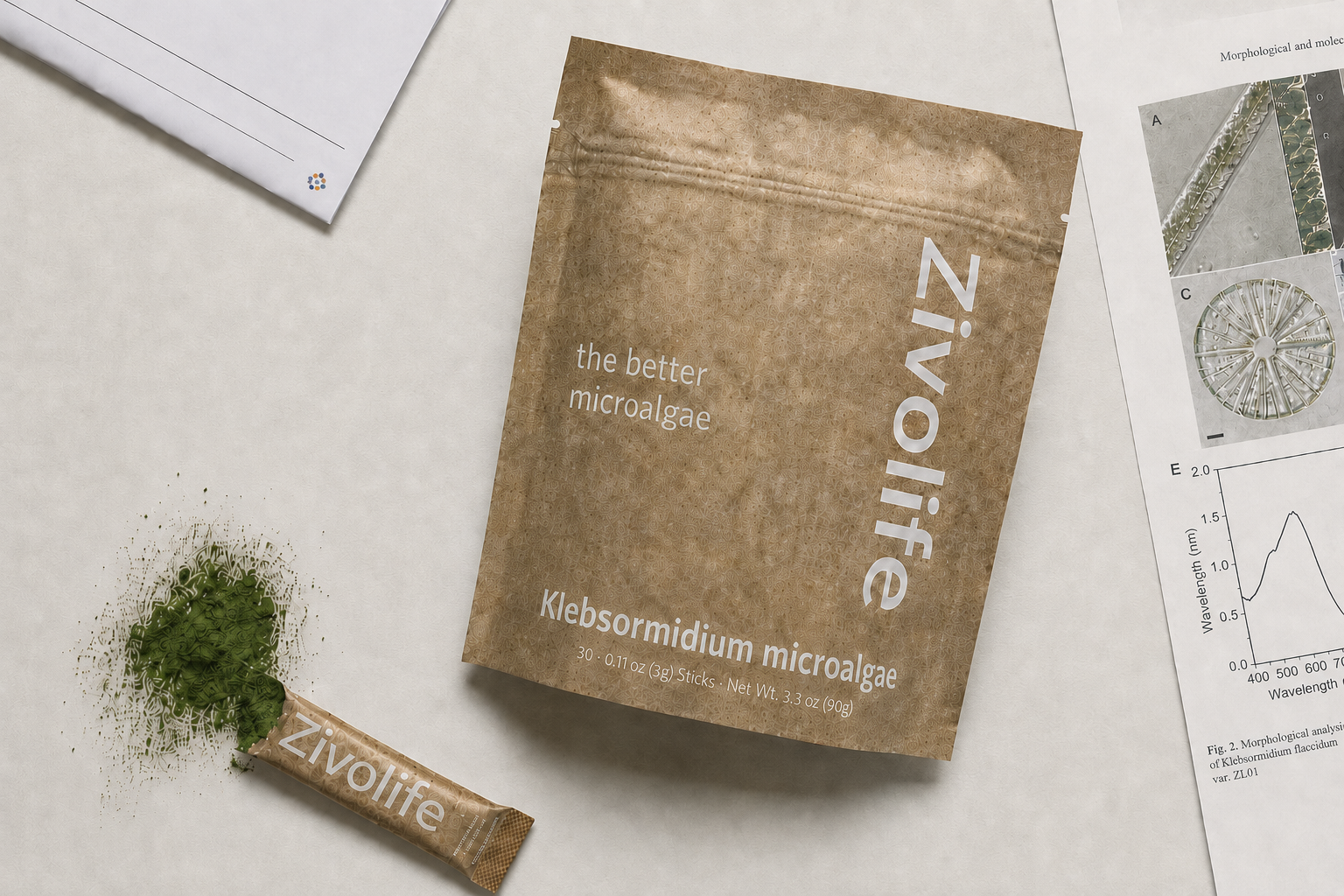
Zivolife is 100 percent Klebsormidium flaccidum var. ZL01. It is worth knowing what that is.
Klebsormidium flaccidum sits at the evolutionary boundary between aquatic algae and land plants. More than 500 million years ago, an organism at that boundary made the transition from water to land, and that transition is the origin of every plant that has followed. This is a lineage that has spent a very long time alongside the bacterial world, learning to live with it rather than against it.
That is the plant in every serving. One whole food, dried at low temperature so its compounds stay intact, with nothing added and nothing removed. Every commercial lot is third-party tested by Eurofins for full nutrient composition, heavy metals, and microbiology before it ships.
Ancient wisdom, or the afternoon tantrum
Your gut is running a conversation with your brain whether you are paying attention to it or not. You do not get to silence it. You do get to choose which side of the table you are feeding.
These statements have not been evaluated by the Food and Drug Administration. Zivolife is a whole food and is not intended to diagnose, treat, cure, or prevent any disease. Third-party testing by Eurofins Scientific is conducted on every commercial lot.