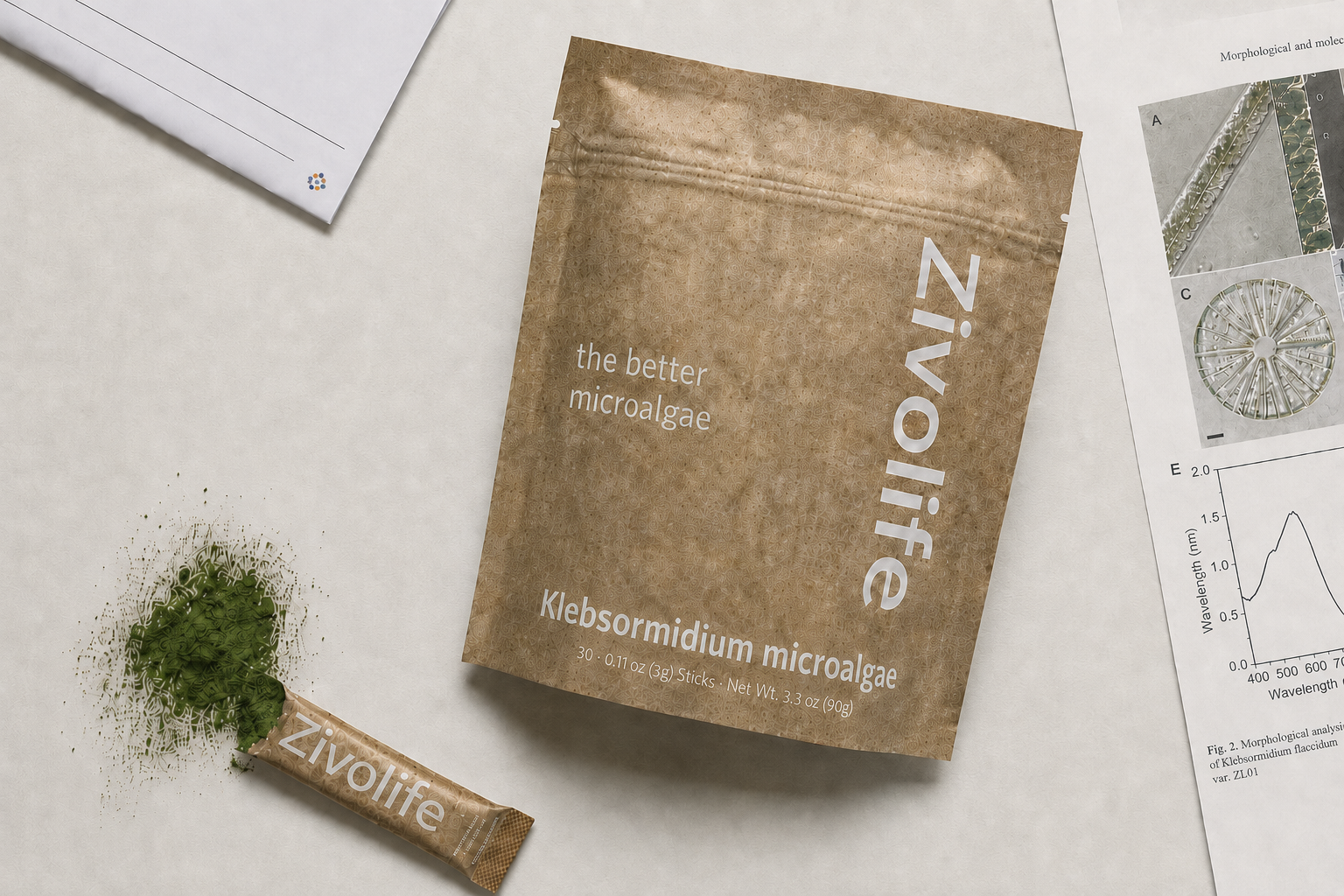
What Organic Certification Doesn't Measure
People ask us, from time to time, why Zivolife isn't certified organic. The honest answer has more layers than you'd expect.
For a microalgae grown in water, true organic certification is close to impossible to achieve at any real commercial scale. And even if it were straightforward, the organic seal doesn't measure the things that actually determine whether a microalgae is clean, pure, and safe to take every day. It was built for a different kind of farming, and it overlooks what matters most for what we grow.
Zivolife is Klebsormidium, a green alga from the lineage that gave rise to land plants, distinct from spirulina (a cyanobacterium) and chlorella (from a different branch of algae). We grow it in water, which is the only reason the organic question touches us at all.
Organic was written for soil
The USDA's National Organic Program was built around farming in the ground. It assumes roots, soil biology, and the things that can go wrong in dirt: synthetic pesticides, chemical fertilizers, runoff into groundwater. Sensible rules for a field of spinach. They were never designed for an organism that grows in water and never touches soil at all.
Microalgae don't have roots. They don't pull nutrients from the earth. They grow in water under controlled conditions, where purity comes down to the water and the inputs rather than the soil. A framework built around soil simply doesn't fit here.
Does genuinely organic microalgae exist?
Microalgae need a highly soluble source of nitrogen to grow at any real volume. The one that works is Chilean sodium nitrate, a naturally occurring mineral source of nitrogen.
In October 2005, the USDA ruled that sodium nitrate could supply no more than 20% of the nitrogen in any certified-organic crop. The logic made sense for soil: highly soluble nitrogen can leach into groundwater from an open field. In a contained water system where nothing seeps into the ground, that risk doesn't exist. But the rule applied anyway.
For microalgae, that 20% limit changes everything. It doesn't allow enough nitrogen to sustain the organism at scale, and there's no organic-approved substitute that performs the same way.
When the 2005 ruling landed, the two largest microalgae producers in the country spent years studying whether they could comply. Both concluded they couldn't meet the new standard without compromising the crop.
These were the most established US producers in microalgae, and they decided "certified organic" wasn't compatible with growing a clean, high-quality product at scale.
How foreign organic gets validated
Most organic microalgae on US shelves is grown overseas, so it's worth knowing how that gets verified. The USDA rarely sends its own inspectors abroad. It relies on accredited outside certifiers and on agreements with foreign governments. Certification is based on periodic audits, not testing of the finished product. Certificate fraud is common enough that the USDA keeps a public registry of fakes it has caught.
A product can carry a valid seal and still have a purity no one independently confirmed. The label records a process. It doesn't measure what's in the packet on your shelf.
What the seal doesn't measure
Organic certification is a process claim. It tells you the algae was grown without GMOs, synthetic fertilizers, or prohibited pesticides. But it speaks to how the food was grown, not to what it absorbed from the environment it grew in.
So the seal says nothing about heavy metals like lead, nothing about microbial contamination, and for microalgae specifically, nothing about cyanotoxins, the toxins some algae produce. The USDA does not test organic microalgae, batch by batch, for any of these. They are the measures that actually tell you whether a product is clean.
For microalgae, that gap matters. As they grow, they absorb what's around them, so their environment, not the growing method, is what determines whether they're clean. And nothing requires these products to be tested for contaminants before sale.
In early 2026, a major US microalgae producer tested 37 top-selling spirulina and greens products, chosen by sales rank across major retail and e-commerce channels. These were trusted, high-volume products, not obscure brands. Third-party testing found that 18 of the 37 exceeded California's Proposition 65 limits for lead. The organic-labeled products fared no better: more than half of the organic mixed greens powders exceeded the limit, and the organic spirulina did not test any cleaner than the conventional.
The problem with blends
Much of the microalgae people consume isn't a standalone product. It's one line on a long ingredient list, inside a greens powder, a multivitamin, or a proprietary blend.
There, "organic spirulina" on the label tells you little about its origin. You usually can't tell which facility grew it, what country it came from, or whether that facility passed the food-safety inspections that govern how a product is made and handled. Those inspections, cGMP and HACCP, are a separate layer from organic entirely. cGMP covers how a facility manufactures, from sanitation to process control; HACCP is the system for identifying and controlling hazards along the way. Organic speaks to neither.
So even a genuine organic certificate on one ingredient leaves you unable to trace what you most want to know: where it came from, and whether it was made somewhere that takes safety seriously. The certificate travels with the ingredient. The accountability often doesn't.
Price can also be an indication. Genuinely clean microalgae is expensive to grow and test, so an unusually low cost "organic" product is often too good to be true. The savings usually trace to low-cost offshore sourcing where oversight is thin.
The standard we hold
Zivolife is a single organism, Klebsormidium flaccidum var. ZL01, an ancient green alga from the branch that gave rise to land plants. We grow our patented strain at commercial scale, never in soil and never with pesticides.
Grown in one facility, so every serving traces back to a single source. Every batch is verified by independent, accredited laboratories before it leaves us, screened for the contaminants that determine whether a whole food is genuinely clean: heavy metals and microbial contamination. Production is held to cGMP and HACCP, internationally recognized standards for how a food is safely manufactured and handled.
We hold Zivolife to a higher bar, and we test it, batch by batch, against the strictest thresholds available.
These statements have not been evaluated by the Food and Drug Administration. Zivolife is a whole food and is not intended to diagnose, treat, cure, or prevent any disease. Third-party testing by Eurofins Scientific is conducted on every commercial lot.