Klebsormidium and the sun: the evolutionary origins of plant photoprotection
Around 500 million years ago, green life left the water. That move onto land gave rise to the entire plant kingdom, and it came with a problem the water had always solved: sunlight. Beneath the surface, water absorbs and scatters the shortest, most energetic ultraviolet wavelengths before they reach a cell. On open land there is no such filter. Any organism making the transition met a flood of light and UV radiation capable of breaking DNA, oxidizing membranes, and dismantling the photosynthetic machinery it depended on to live. The lineages that survived did so by evolving a defense, one that predates the plant kingdom itself. One of its original architects is still here.
An ancient answer to the problem of light
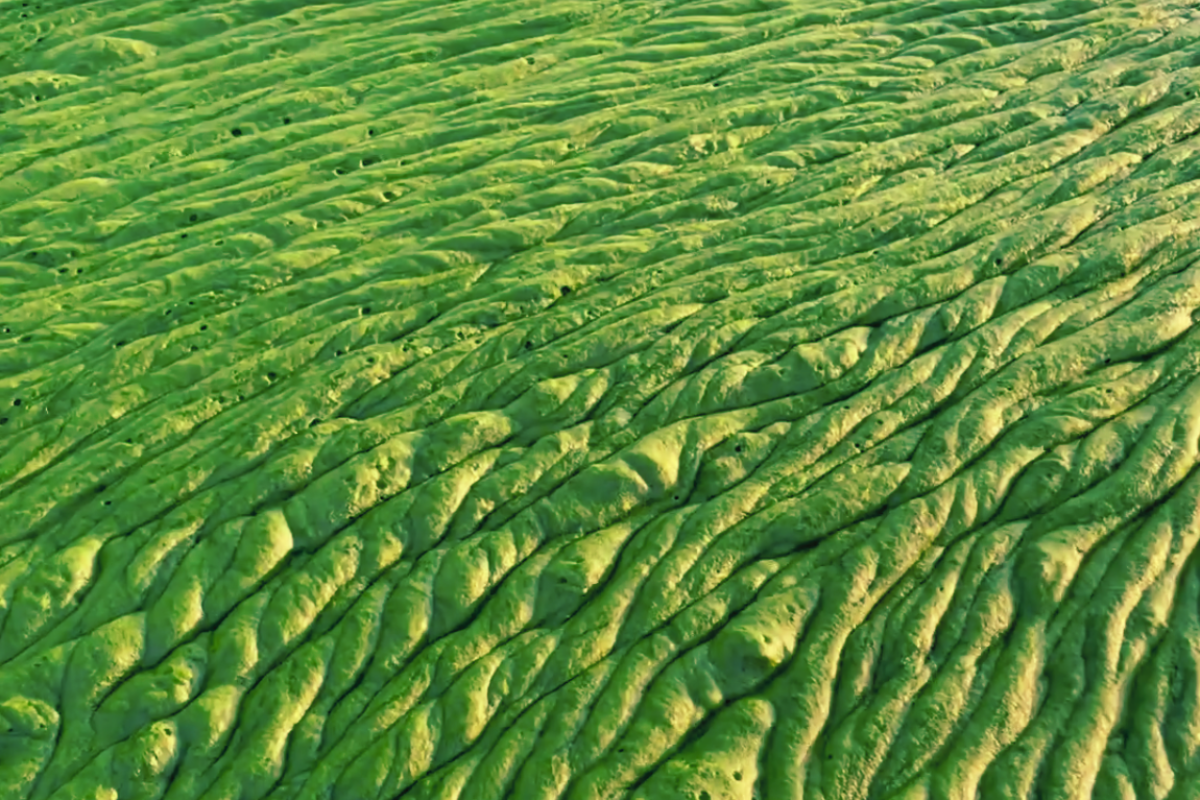
The organisms at that water-to-land boundary were the charophytes, the freshwater green algae that are the closest living relatives of land plants. Klebsormidium is one of the earliest-branching members of that lineage, and it never left the frontier. It lives today in biological soil crusts around the world, from hot deserts to High Arctic rock at 78 degrees north, colonizing bare, exposed surfaces where few photosynthetic organisms can hold on. These are among the most UV-intense habitats on the planet, and Klebsormidium does not merely tolerate them. It has thrived in them, essentially unchanged in its basic strategy, since before forests, before flowers, before the first root reached into soil.
Understanding how it manages that is not a botanical footnote. It is the record of how photosynthetic life became compatible with direct sun in the first place.
The toolkit that plants inherited
When researchers sequenced the genome of Klebsormidium flaccidum in 2014, they found something striking: the alga already carried much of the molecular equipment long assumed to be a land-plant invention. The paper's title put it plainly, describing a genome that reveals primary factors for plant terrestrial adaptation (Hori et al., 2014, Nature Communications). Genes for stress signaling, for the plant hormones that coordinate its response to the environment, and for the machinery that manages high light were present in an alga that predates plants entirely.
Central to that machinery is photoprotection built on pigments. Carotenoids, including the xanthophylls lutein and zeaxanthin, do double duty in a photosynthetic cell. They help harvest light, and when light becomes excessive they safely dissipate the surplus energy as heat and neutralize the reactive oxygen species that intense sun generates. This carotenoid-based defense, along with antioxidant enzyme systems and proteins that protect the cell through dehydration, was largely assembled in the charophyte algae before land plants existed. When plants finally colonized the land, they inherited it wholesale. The evidence now points to most of the terrestrial toolkit being present in these algal ancestors first, then carried forward into every plant that followed.
Land plants did add to it. Facing relentless UV-B, they evolved a dedicated sunscreen chemistry of their own, built on flavonoids produced through the phenylpropanoid pathway and triggered by a UV-B sensor called UVR8. In doing so they largely replaced an older class of algal UV-screening compounds, the mycosporine-like amino acids, with flavonoids (Delaux et al., 2022). The deep carotenoid and antioxidant systems, though, were never traded away. They are the shared inheritance, the part of the sun-survival program that runs from the first alga on land straight through to the spinach in your refrigerator.
The sunscreen Klebsormidium kept
Klebsormidium is notable for what it held onto. While the plant lineage moved to flavonoids, this alga retained its ancestral ultraviolet screen. In 2020, a research team isolated two previously unnamed UV-absorbing compounds and named them after the genus itself: klebsormidin A and klebsormidin B (Hartmann et al., 2020, Frontiers in Microbiology).
Klebsormidins are mycosporine-like amino acids, and they work like a molecular parasol. They absorb ultraviolet energy at around 324 nanometers and release it as harmless heat before it can drive a damaging photochemical reaction. What makes them a true defense rather than a fixed trait is that the alga makes them on demand. Under stronger ultraviolet exposure, Klebsormidium raised its production of these compounds several-fold in controlled experiments. More light, more protection. It is one of the oldest active sun-survival strategies still running, and it earned the organism the rare distinction of a compound that carries its name.
What that evolution produced is a whole plant, not an extract
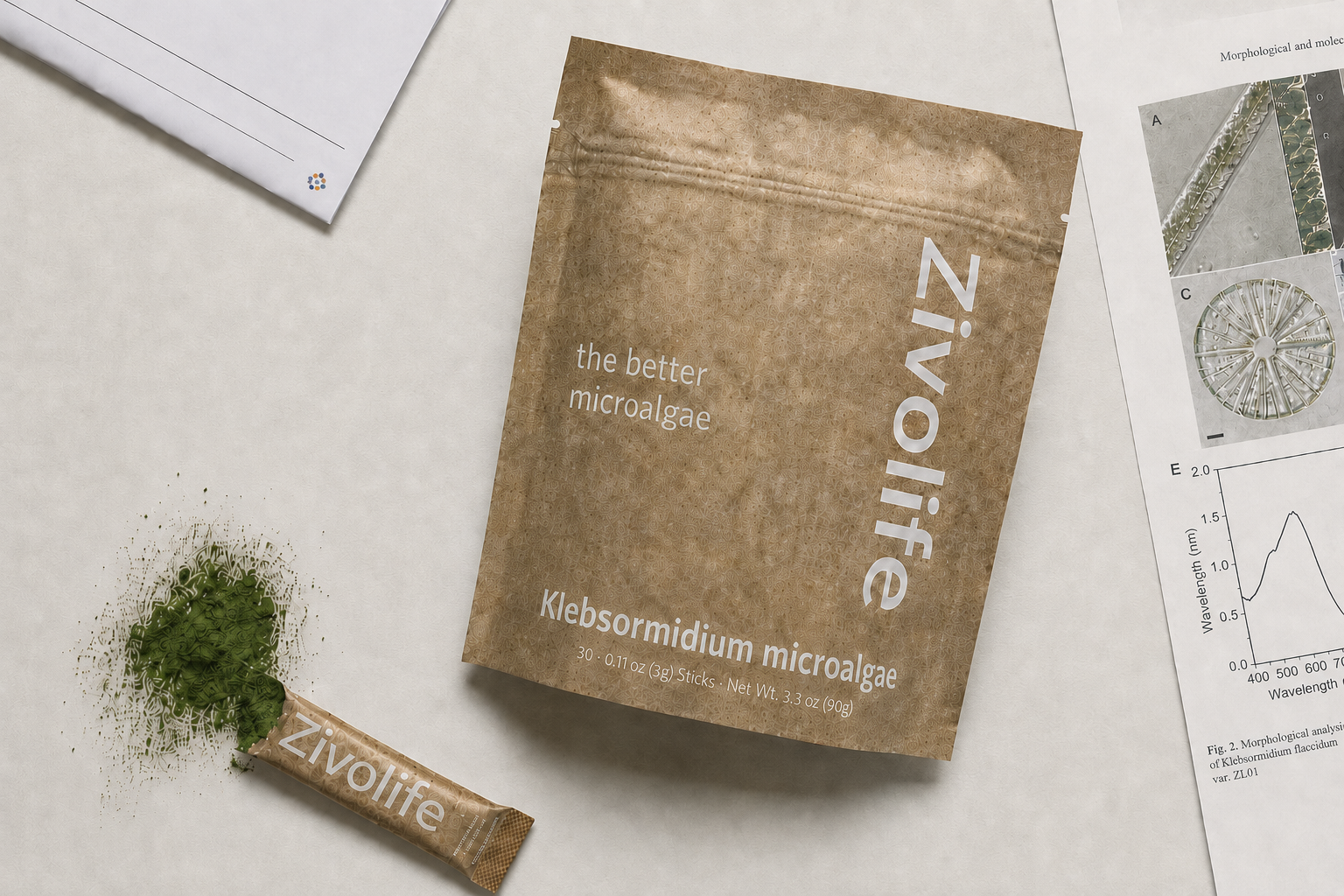
Zivolife is Klebsormidium flaccidum var. ZL01, a cultivated variant of that same lineage, grown and dried whole. The reason this matters is that half a billion years of evolving to survive sun, drought, and open exposure did not produce one clever molecule. It produced a dense, integrated matrix of pigments, antioxidants, and nutrients, all of it present together in a single organism.
The antioxidant pigments are the direct legacy of the sun-survival story. Independent testing by Eurofins documents the dried plant at 241 mg of lutein and 84 mg of zeaxanthin per 100 grams, with 411 mg of total carotenoids, alongside chlorophyll and a spectrum of plant polyphenols. Beta-carotene, one of those pigments, is also the plant's source of vitamin A: in any plant food, vitamin A arrives as provitamin A carotenoids the body converts to retinol, rather than as preformed vitamin A, and in Zivolife it is documented at 3,168 IU per 100 grams.
Around that pigment core sits the rest of the whole-food profile. Per 100 grams, the plant supplies 52 grams of complete plant protein with all nine essential amino acids, 14 grams of whole-food fiber, 142 mg of iron, and more than 2,000 mcg of vitamin K1, along with calcium, potassium, zinc, vitamin E, and B vitamins. Gram for gram, it is one of the most nutrient-dense plant foods on the planet, and every commercial lot is tested by Eurofins. Nothing is added, extracted, or reassembled. What you eat is the matrix as the alga evolved it.
Carotenoids, and what reaches your skin
There is a reason the carotenoid part of that matrix has drawn interest well beyond botany. In humans, dietary carotenoids are absorbed and deposited in tissues throughout the body, skin included. Being fat soluble, they settle into the skin's lipid layers, the same layers where ultraviolet light does much of its oxidative damage, and there they act as antioxidants just as they do in the plant.
Controlled human trials have measured the effect. In a body of randomized studies reviewed by Baswan and colleagues (2021), several weeks of steady carotenoid intake raised the skin's minimal erythema dose, the exposure it takes before skin reddens, with the effect building over roughly eight to twelve weeks. It is real and measurable rather than dramatic. Dietary carotenoids support the skin's own antioxidant defense from within, across the whole surface at once, and they work alongside topical sunscreen rather than in place of it. Keep wearing the SPF. What food adds is a second layer, the internal one, built from the inside on the pigments you eat every day.
That is the throughline worth sitting with. The carotenoid antioxidant defense that helps quiet UV stress in your skin is the same defense an alga evolved to survive the first sunlight on land, half a billion years ago. Klebsormidium built it early and kept it whole. In Zivolife, that is exactly how you get it.
─────────────────────────────────────────
These statements have not been evaluated by the Food and Drug Administration. Zivolife is a whole food and is not intended to diagnose, treat, cure, or prevent any disease. Third-party testing by Eurofins Scientific is conducted on every commercial lot.