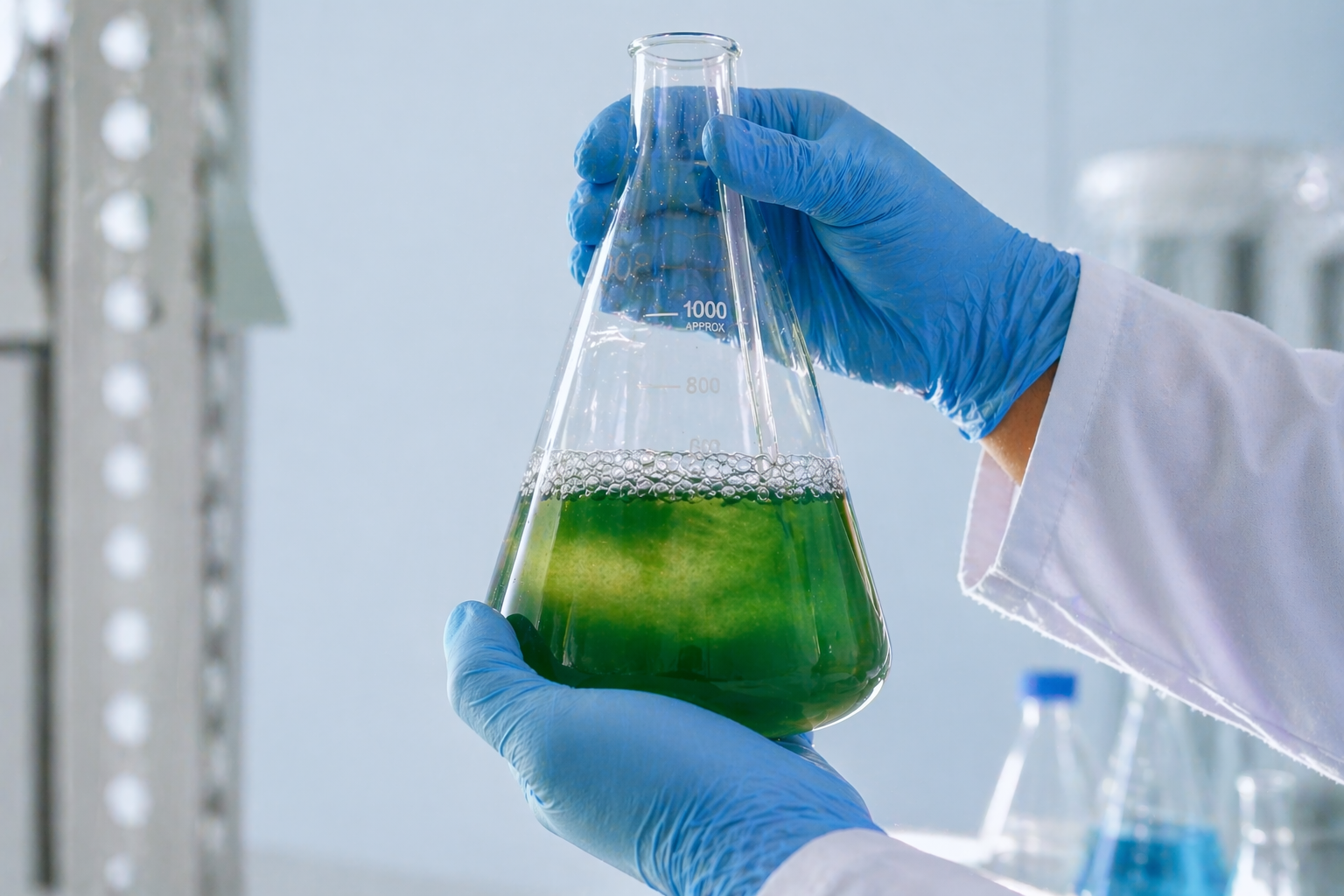
Pheophorbide a and the brain: the 2020 research on Klebsormidium flaccidum
A 2020 peer-reviewed paper from the University of Mississippi identified pheophorbide a as one of the most potent natural inhibitors of iNOS, a central enzyme in neuroinflammatory research. The plant they studied is Klebsormidium flaccidum var. ZL01, aka Zivolife.
Inflammatory signaling in the brain rarely announces itself. Most people don't feel it as inflammatory activity. They feel it as a dulling. A word that should be there and isn't. A task that used to take twenty minutes now taking forty.
The research community has spent the last fifteen years tracing these experiences back to a family of enzymes that sit quietly overactive in the central nervous system. One of them, iNOS (inducible nitric oxide synthase), has become a central target of neuroinflammatory research.
In 2020, a team at the University of Mississippi published a peer-reviewed paper identifying a natural compound with iNOS-inhibiting activity unusual for a naturally occurring compound.¹ The compound is pheophorbide a. The plant they studied is Klebsormidium flaccidum var. ZL01, aka Zivolife. Here's what they found.
What pheophorbide a actually is
Pheophorbide a is what chlorophyll becomes when it starts to break down. Every green plant contains chlorophyll, and chlorophyll can start to break down in a few ways: as a leaf wilts, as plants senesce (plant aging), or during digestion. What's left is pheophorbide a.
In most of these contexts, pheophorbide a forms briefly and in trace amounts. What makes Klebsormidium flaccidum var. ZL01 different is that pheophorbide a is present in the plant at meaningful, stable amounts.
Using a technique called chemometric analysis, the Mississippi team identified pheophorbide a as one of the most potent compounds in Zivolife for inhibiting iNOS in laboratory cell models. The measured IC50, which is the concentration required to reduce iNOS activity by half in those cells, was 0.24 micromolar. That is a level of potency rare for a natural compound.
In plain terms: pheophorbide a is what chlorophyll becomes as it breaks down. In most plants it barely registers. In Klebsormidium flaccidum var. ZL01 it is present in meaningful amounts.
Why iNOS matters in the brain
iNOS is not inherently harmful. The enzyme plays a legitimate role in the immune system, helping the body respond to pathogens and tissue damage. The problem is sustained activation. iNOS is switched on by signals from cells under stress, whether from injury, infection, or ongoing inflammatory load. When those signals don't resolve, the enzyme stays on, and its continuous production of nitric oxide begins to damage the cells around it.
In the brain, this matters more than almost anywhere else. Neurons are vulnerable to the chemical stress nitric oxide produces when it accumulates, and unlike skin cells or muscle cells, they don't replicate easily. Cumulative damage builds up over years.
The broader research literature links chronic iNOS overactivation in the central nervous system to a range of contexts in which inflammatory signaling is implicated, including cognitive decline in aging populations, mood dysregulation, neurodegenerative conditions such as Alzheimer's and Parkinson's disease, the mental slowness that sometimes follows viral infection, and the extended recovery seen after traumatic brain injury and repeated concussion. This is established science on the biology of iNOS, independent of any particular compound or food.
Within that broader research context, the 2020 Mississippi finding is a compound-level, in vitro observation: pheophorbide a inhibits iNOS in cell models at low concentrations, and it does so as a component of a whole food with an established safety profile. Natural source, potency of a kind rarely documented in food compounds. That combination is unusual in the research literature.
In plain terms: iNOS is an enzyme your body needs in short bursts. When it stays switched on, damage can build up over time. The 2020 study found that pheophorbide a is a potent inhibitor of this enzyme in laboratory cell models.
The broader inflammatory map
Pheophorbide a doesn't just act on iNOS. The same Mississippi paper found it also inhibits NF-kappaB, a master switch known to control more than five hundred genes involved in inflammatory signaling throughout the body. Because those same signaling pathways show up in joints, muscle tissue, the gut lining, and the blood vessels, the compound's mechanistic relevance extends well beyond cognition.
An unrelated 2021 study in the journal Life tested pheophorbide a in human skin fibroblasts and reported activity against collagen breakdown with implications for skin aging.² Taken together with the Mississippi findings in macrophages and chondrocytes, the picture is of a compound that acts on inflammatory signaling across multiple tissue types in measurable, reproducible ways in cell-based research.
A note on chlorophyll drinks and extracts
This is worth addressing: chlorophyll drinks, extracts, and supplements are not a practical route to pheophorbide a. Most of these products contain chlorophyllin, a stabilized, water-soluble form of chlorophyll chemically modified to survive on a shelf and pass through the body intact. Stability is the whole point. Pheophorbide a, by contrast, is what chlorophyll becomes when it does break down. The two are related but they are not the same molecule. To consume pheophorbide a as food, you need a plant whose chemistry produces and holds it naturally. Klebsormidium flaccidum var. ZL01 is one of the few studied in detail that does.
Why you don't find it everywhere
If pheophorbide a is this interesting, why isn't it a common nutritional compound? The short answer is that it requires a specific kind of plant.
Pheophorbide a forms transiently in many places, but it accumulates measurably in very few. Most commercial microalgae products don't contain it in meaningful amounts. Spirulina and chlorella belong to different taxonomic classes, with different pigment profiles and different degradation pathways. Klebsormidium flaccidum sits at the evolutionary boundary between aquatic algae and land plants, which gives it a different biochemistry.
The second reason is nutritional. Klebsormidium flaccidum belongs to the charophytes, the algal lineage from which all land plants evolved. That evolutionary position gives charophytes a distinctive chemistry, with compounds and metabolic features that later diversified across the plant kingdom. The Zivolife variant expresses this chemistry in a form that has been characterized in peer-reviewed research. The pheophorbide a profile isn't incidental to the organism. It is a stable feature of what this plant is.
Where this leaves us
None of this is an argument to consume pheophorbide a for the express purpose of inhibiting iNOS. The body's inflammatory signaling is precisely calibrated across many pathways at once, and the goal of nutrition is to support its healthy regulation, not to shut any one part of it off.
The value of the 2020 Mississippi finding is quieter than that. It places a compound with reproducible mechanistic activity inside a single whole plant, one that can be eaten daily as food. Alongside polyphenols, carotenoids, beta-glucans, and a complete protein profile, pheophorbide a is one of the compounds that makes Klebsormidium flaccidum var. ZL01 biochemically distinct from any other microalgae available commercially.
The science is not finished. The research is at the mechanistic and preclinical stage, conducted in cell models rather than in human trials, and conclusions about outcomes in the body are not the purpose of this article. But the direction of the work suggests this compound has a role in the conversation about healthy aging, cognitive resilience, and inflammatory regulation that is only beginning to be written. Zivolife is the only commercial food source of Klebsormidium flaccidum var. ZL01 anywhere in the world.
References
- Qiu, S., Khan, S.I., Wang, M., Zhao, J., Ren, S., Khan, I.A., Steffek, A., Pfund, W.P., & Li, X.-C. (2020). Chemometrics-assisted identification of anti-inflammatory compounds from the green alga Klebsormidium flaccidum var. zivo. Molecules, 25(5), 1048. DOI: 10.3390/molecules25051048
- Lee, Y., Hyun, C.-G. (2021). Anti-inflammatory effects of pheophorbide a through the inhibition of LPS-induced NO and PGE₂ production in RAW 264.7 macrophages. Life, 11(2), 142. (Exact citation to be verified against the Life 2021 paper referenced in the article.)
Zivolife is a whole food, not a medicine. This article is for informational purposes only and discusses peer-reviewed research on pheophorbide a as a compound. It is not a substitute for professional medical advice and does not claim that Zivolife treats, prevents, or modifies any disease. If you have concerns about a specific health condition, consult your healthcare provider.